Sep 07, 2026
In modern steel construction, C and Z purlins are widely used as secondary structural members for industrial buildings, warehouses, workshops, logistics centers, agricultural buildings, and prefabricated structures. Because purlins directly affect the stability, installation efficiency, and overall cost of a steel building, choosing the right C/Z purlin roll forming machine is an important decision for manufacturers and contractors.
A suitable purlin machine should not only produce accurate profiles, but also offer stable production, flexible size adjustment, efficient punching and cutting, and reliable long-term operation. For buyers who are planning to invest in a new production line, understanding the key machine configurations can help reduce unnecessary investment and improve future production efficiency.
1. Understand Your Required Purlin Sizes
The first step in choosing an automatic purlin roll forming machine is to clearly identify the profile sizes required for your market. Different construction projects may require different purlin dimensions; common sizes can range from approximately 100 mm to 300 mm or even larger, depending on the building design and structural load. For example, smaller profiles are commonly used for light steel buildings, while larger purlins may be required for large-span industrial buildings or heavy-duty structures.
Before purchasing a machine, buyers should confirm several basic parameters:
Web width, Flange width, and Lip size
Steel thickness range
C profile, Z profile, or both
Required production speed
Punching hole position & pattern
Cutting length specifications
A machine with a wider production range offers greater flexibility, especially for factories that serve different customers or project types.
2. Automatic C/Z Changeover Can Improve Production Efficiency
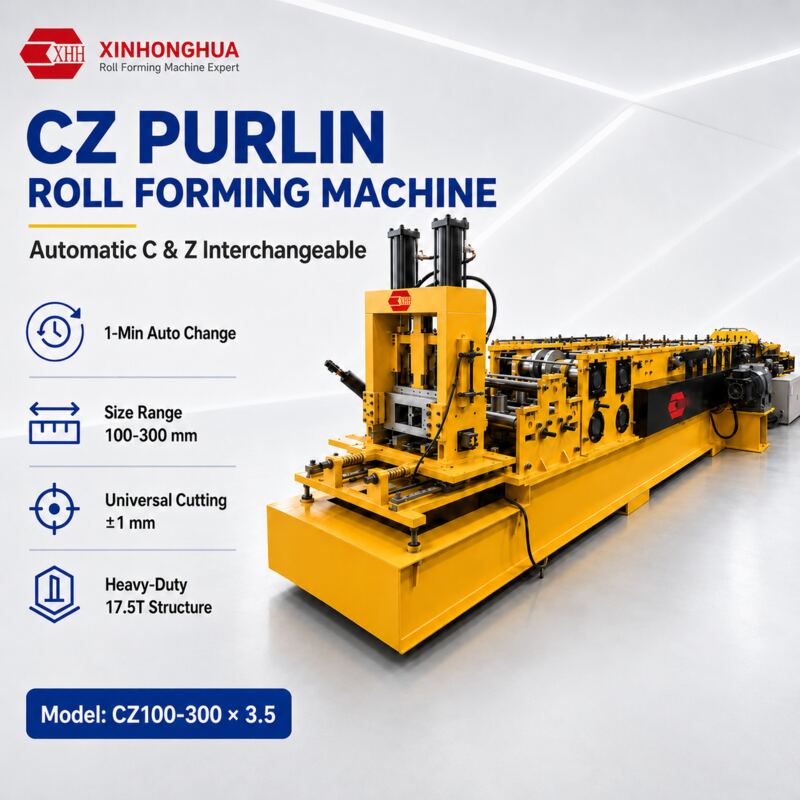
Traditional purlin machines may require operators to manually adjust rollers or replace certain machine components when changing from one profile size to another. For factories that frequently produce different specifications, this process can take significant time and increase labor costs. Modern automatic C/Z purlin roll forming machines are designed to simplify this adjustment process significantly.
With PLC control, operators can input the required dimensions through the touch screen, and the machine can automatically adjust the forming stations according to the production settings. Some machines can also switch between C and Z profiles without manually replacing rollers, which is particularly useful for manufacturers handling small-batch and multi-size orders. The main advantages include:
Reduced machine adjustment time
Lower labor requirements
Higher production efficiency
Better dimensional consistency
Faster response to customized orders
For companies that produce only one or two fixed sizes, a conventional machine may still be sufficient. However, for manufacturers seeking flexible production, an automatic adjustable machine is usually a better long-term investment.
3. Steel Thickness and Material Strength Are Important
The thickness and strength of the steel coil directly affect the machine structure and forming design. Common purlin materials include galvanized steel and high-strength structural steel. Depending on the market and application, steel thickness may range from approximately 1.0 mm to 3.0 mm or more. A machine designed for thin steel may not perform well when continuously processing thicker or higher-strength material.
Therefore, buyers should provide the machine supplier with accurate material data:
Maximum and minimum steel thickness
Material grade and yield strength
Galvanized coating requirements
High-strength steel requires stronger shafts, rollers, transmission systems, and machine frames. If the machine structure is insufficient, long-term production may lead to dimensional deviation, excessive vibration, roller wear, or forming instability. For this reason, machine design should always match the real production material rather than only the profile dimensions.
4. Punching System Configuration
Most C/Z purlins require holes for installation and connection. An integrated hydraulic punching system allows the machine to automatically punch holes according to the programmed production data. Depending on the customer's project requirements, the punching system can be designed for different hole shapes and positions, such as round holes, slotted holes, web punching, flange punching, multiple punching stations, and customized hole spacing.
For projects with repeated specifications, automatic punching can significantly reduce secondary processing. Instead of forming the purlin first and drilling holes manually afterward, the production line can complete punching, forming, measuring, and cutting in one continuous process, which improves production efficiency and helps reduce labor errors.
5. Pre-Cutting or Post-Cutting?
Another important machine configuration is the cutting system, which generally includes two common methods: pre-cutting and post-cutting. A pre-cutting system cuts the steel strip before it enters the forming section; this structure is relatively simple and can reduce the need for multiple cutting dies. In contrast, a post-cutting system cuts the finished profile after roll forming, offering better control over the finished length for specific production requirements.
The correct cutting method depends on profile design, production speed, machine structure, and customer requirements. For adjustable C/Z purlin machines producing multiple sizes, the supplier should carefully design the cutting system to ensure clean cutting edges and consistent finished dimensions.
6. PLC Control and Automatic Production
A modern purlin roll forming line should have an easy-to-use PLC control system. Operators can normally enter production information such as product length, required quantity, profile size, punching position, and batch information. After the parameters are entered, the machine performs automatic production according to the program while monitoring output quantities and providing operational alarm prompts.
A user-friendly control interface reduces training time and makes daily production easier for factory workers. For overseas customers, English-language control interfaces are standard, and other languages can also be customized depending on project requirements.
7. Production Speed Should Match Your Actual Demand
Higher speed is not always better. Some buyers focus heavily on the maximum forming speed when comparing machines; however, real production efficiency depends on the complete production process, including feeding, punching, forming, cutting, and material handling. For example, if the forming section operates very quickly but the punching system requires frequent stops, the actual average production speed may still be lower. Therefore, buyers should evaluate realistic working speeds rather than theoretical maximums.
For many steel building manufacturers, a stable and reliable production speed is more valuable than extremely high speed. Stable operation helps reduce material waste, machine downtime, dimensional errors, maintenance frequency, and unexpected production interruptions.
8. Machine Frame and Roller Quality
The mechanical structure is one of the most important factors affecting machine life. A strong machine frame helps maintain forming accuracy during long-term operation, and rollers should be manufactured with suitable material and precision machining. Depending on configuration, rollers may receive heat treatment or surface finishing to improve hardness and wear resistance.
Important components such as shafts, bearings, gearboxes, hydraulic systems, and electrical parts should also be selected according to the expected production load. A heavier and stronger machine is often more suitable for long-term industrial production, especially when processing thicker or higher-strength steel.
9. Customized Production Requirements
Different countries and customers may have different standards and building practices. For example, purlin sizes used in Australia may differ from those commonly used in Europe, South America, Southeast Asia, or the Middle East. Some customers may also require customized punching patterns, special flange dimensions, unique profile designs, or additional marking systems.
A professional roll forming machine supplier should be able to design the machine according to the customer's profile drawing and material specifications. Before production, buyers should provide detailed drawings showing all important dimensions, allowing the engineering team to confirm the roller design and avoid misunderstandings during machine manufacturing.
10. Installation, Training, and After-Sales Support
A roll forming machine is a long-term industrial investment; therefore, after-sales support should also be considered when selecting a supplier. A reliable supplier should provide technical documents including machine operation manuals, electrical and hydraulic diagrams, installation instructions, maintenance guidelines, and spare parts lists.
Remote technical support can help solve many common operating problems quickly. For more complex projects, overseas installation or technician support can also be scheduled. Before ordering, customers should clearly discuss installation, commissioning, training, warranty, and spare parts support with the machine manufacturer.
Conclusion
Choosing the right C/Z purlin roll forming machine requires more than comparing machine prices. Buyers should carefully consider profile dimensions, steel thickness, material strength, automatic adjustment, punching requirements, cutting method, control system, production speed, machine structure, and after-sales support. For manufacturers producing multiple sizes or customized orders, an automatic adjustable C/Z purlin machine can significantly improve production flexibility and reduce adjustment time.
Xiamen Xinhonghua Machinery Co., Ltd. provides roll forming solutions for different steel building applications. Our C/Z purlin roll forming machines can be customized according to customers' profile drawings, steel thickness, punching requirements, electrical standards, and production needs.
If you are planning a new purlin production line, providing your profile drawings and material specifications will help our engineering team recommend a suitable machine configuration for your project.
Read More

 IPv6 network supported.
 +86 13605085003
 sunnie@xhhjx.com


