Purchasing a light steel frame machine is a major investment for manufacturers entering or expanding in the prefabricated building industry.
The correct machine can improve production efficiency and allow a factory to produce framing components for different building projects. However, choosing a machine only by comparing price can create problems later.
Different light steel framing systems have different requirements for profile dimensions, steel thickness, punching positions, software, and automation.
Before purchasing a machine, buyers should clearly understand their own production requirements.
1. Understand Your Main Building Application
The first question is simple:
What type of building will the machine produce?
Light steel framing equipment can be used for many applications, including villas, residential houses, modular buildings, temporary accommodation, construction site buildings, and prefabricated commercial structures.
Different projects may require different framing systems.
For example, a company mainly producing small houses may focus on flexible profile production and fast project switching.
A modular building manufacturer may focus more on production capacity, repeatability, and integration with digital design systems.
Understanding the final application helps determine the correct machine configuration.
2. Confirm the Required Profile Size
Profile dimensions are one of the most important technical factors.
Different light steel construction systems use different stud and track sizes.
Before purchasing equipment, customers should provide the machine manufacturer with the profile drawings or required dimensions.
Important information normally includes web width, flange size, lip size, steel thickness, and profile shape.
If a company expects to produce several profile sizes, it should confirm whether the machine supports automatic or manual size adjustment.
Choosing the correct size range at the beginning can prevent expensive modifications later.
3. Check the Steel Thickness Range
Steel thickness directly affects machine structure, forming rollers, drive system, and punching system.
A machine designed for relatively thin residential framing may not be suitable for continuously processing heavier material.
The customer should therefore confirm the normal material thickness used in their projects.
It is also useful to consider future projects.
If the company expects to enter heavier modular or structural framing markets later, choosing a machine with a suitable processing range can provide more flexibility.
4. Review Punching and Cutting Requirements
Modern light steel framing systems usually require more than simple roll forming.
Profiles may require holes, slots, connection holes, service holes, notches, or other processing features.
These features allow components to connect with each other and simplify installation of electrical, plumbing, and structural elements.
Before purchasing the machine, the buyer should provide sample drawings or project files showing the required processing positions.
The equipment manufacturer can then determine the necessary punching and cutting configuration.
A suitable punching system can reduce secondary processing after the profile leaves the machine.
5. Consider Software Compatibility
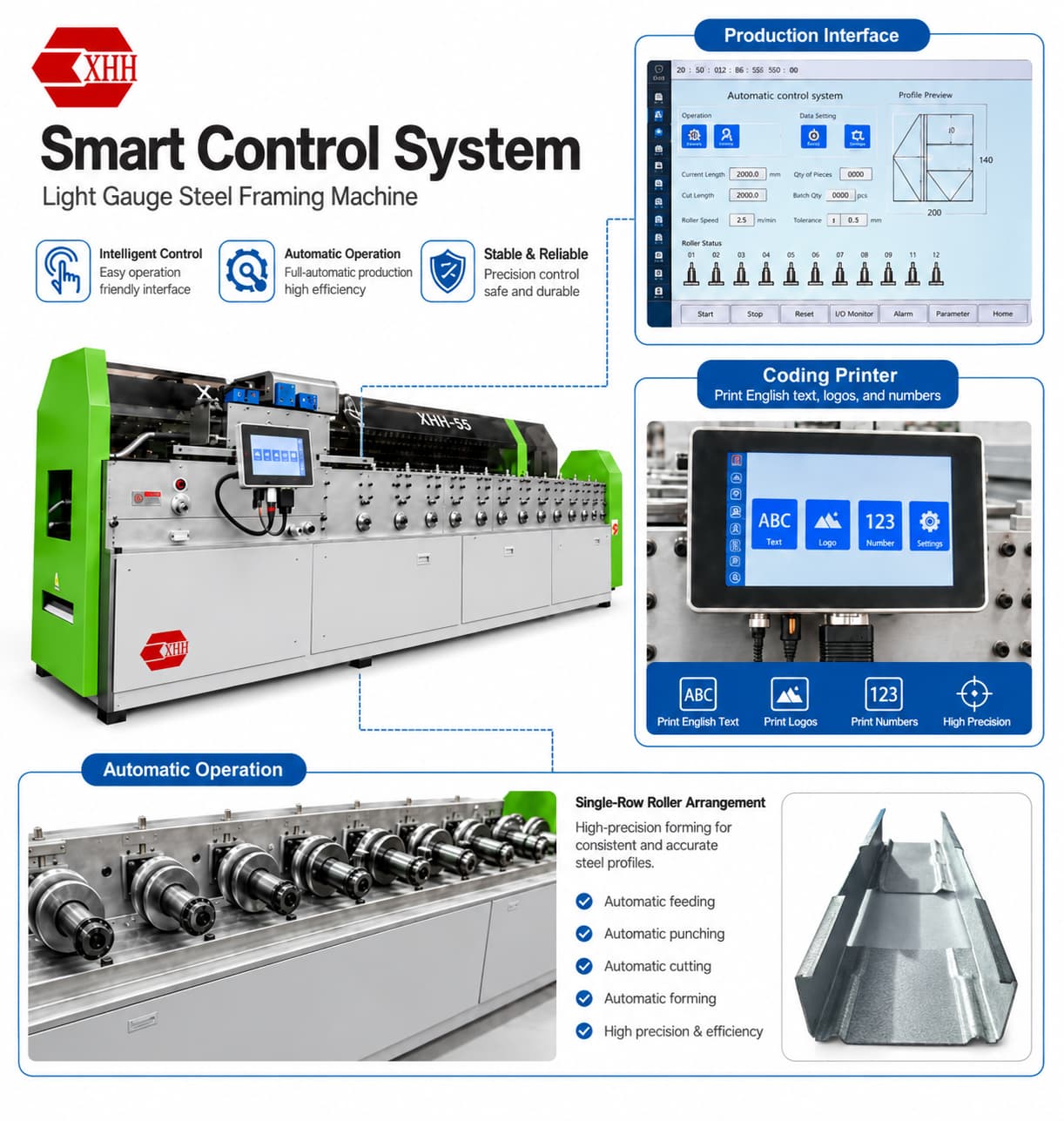
Software is becoming one of the most important parts of an automated light steel framing production line.
Many manufacturers design buildings using CAD or BIM software.
The production data generated by the design system can then be transferred to the machine.
This allows framing components to be produced automatically according to the building model.
Before purchasing a machine, customers should confirm how the machine receives production data and whether it is compatible with their existing design workflow.
Good software integration can reduce manual data entry and minimize production errors.
For companies planning to build a highly automated factory, software compatibility should be considered as seriously as the mechanical equipment itself.
6. Evaluate Production Speed Carefully
Production speed is often used as a major selling point, but the highest speed is not always the most important factor.
Actual production efficiency depends on the complete production process.
Punching frequency, number of holes, profile length, material type, and project complexity can all affect real production speed.
Therefore, buyers should ask about practical production capacity rather than only maximum forming speed.
For example, a machine producing a simple long profile may operate much faster than when producing short components with multiple punching operations.
A realistic production test using the customer's own profile design can provide more useful information.
7. Pay Attention to Machine Structure
A stable machine frame is important for long-term operation.
Roll forming machines operate continuously and must maintain accurate roller alignment.
A strong machine base, properly designed roller stands, reliable transmission system, and stable hydraulic system can help maintain production quality.
Buyers should examine the overall machine structure rather than focusing only on the appearance of the equipment.
It is also important to understand which components require regular maintenance.
Easy access to rollers, cutting units, hydraulic systems, and electrical components can reduce future maintenance time.
8. Check Electrical Standards
Electrical requirements vary between countries.
Voltage, phase, and frequency should therefore be confirmed before the machine is manufactured.
For export machines, the control cabinet and electrical system should be configured according to the customer's local power standard.
Safety requirements may also differ between markets.
Buyers should communicate any required safety standards, electrical certifications, guarding systems, or emergency stop requirements before production.
This is especially important for equipment exported to markets such as Australia, Europe, North America, and other regions with specific machinery safety requirements.
9. Ask About Installation and Training
A good machine still requires correct installation and operator training.
Before purchasing, buyers should understand what support is provided after delivery.
This may include machine installation guidance, remote technical support, operation manuals, electrical drawings, training videos, spare parts support, or on-site service depending on the project.
Operators should understand how to load materials, change production settings, manage project files, perform daily inspection, and maintain the equipment.
Good training helps factories reach stable production more quickly.
10. Compare Total Value, Not Only Price
It is natural for buyers to compare machine prices from several suppliers.
However, the lowest initial price does not always result in the lowest production cost.
Machine reliability, software capability, production accuracy, spare parts availability, technical support, and downtime can have a much larger impact over the lifetime of the equipment.
A machine that reduces material waste, minimizes manual processing, and improves production efficiency may create more value even if the original purchase price is higher.
For this reason, customers should evaluate the total production solution rather than only the quotation price.
The Importance of Testing Before Delivery
For customized light steel framing equipment, factory testing is an important step.
The machine should be tested using suitable steel material and representative profile designs.
The customer can check profile dimensions, punching positions, cutting accuracy, forming quality, and overall machine operation.
When possible, sample components can also be assembled to confirm that they match the required building system.
This testing process helps identify potential problems before the machine is shipped.
Conclusion
Choosing the right light steel frame machine requires more than selecting a model from a catalogue.
The machine should match the customer's building system, material specifications, profile dimensions, software workflow, punching requirements, and production capacity.
A clear discussion between the buyer and machine manufacturer before production can significantly reduce future problems.
As light steel construction becomes increasingly automated, equipment is becoming closely connected with digital design and prefabricated building systems.
For manufacturers planning long-term production, choosing a flexible, reliable, and properly configured light steel framing machine can provide a strong foundation for future business growth.

 IPv6 network supported.
 +86 13605085003
 sunnie@xhhjx.com