Light gauge steel construction is expanding across modular homes, villas, low-rise apartments, offices, schools, and accessory dwelling units. For manufacturers entering this market, one of the first equipment decisions is whether to invest in a C89 or C140 light gauge steel framing machine. Both systems can produce accurate cold-formed steel members, but they are designed for different structural requirements, material ranges, and project types.
This guide compares C89 and C140 framing systems from a production perspective. It explains profile size, material thickness, applications, punching and cutting requirements, software integration, and the information a buyer should prepare before requesting a machine quotation.
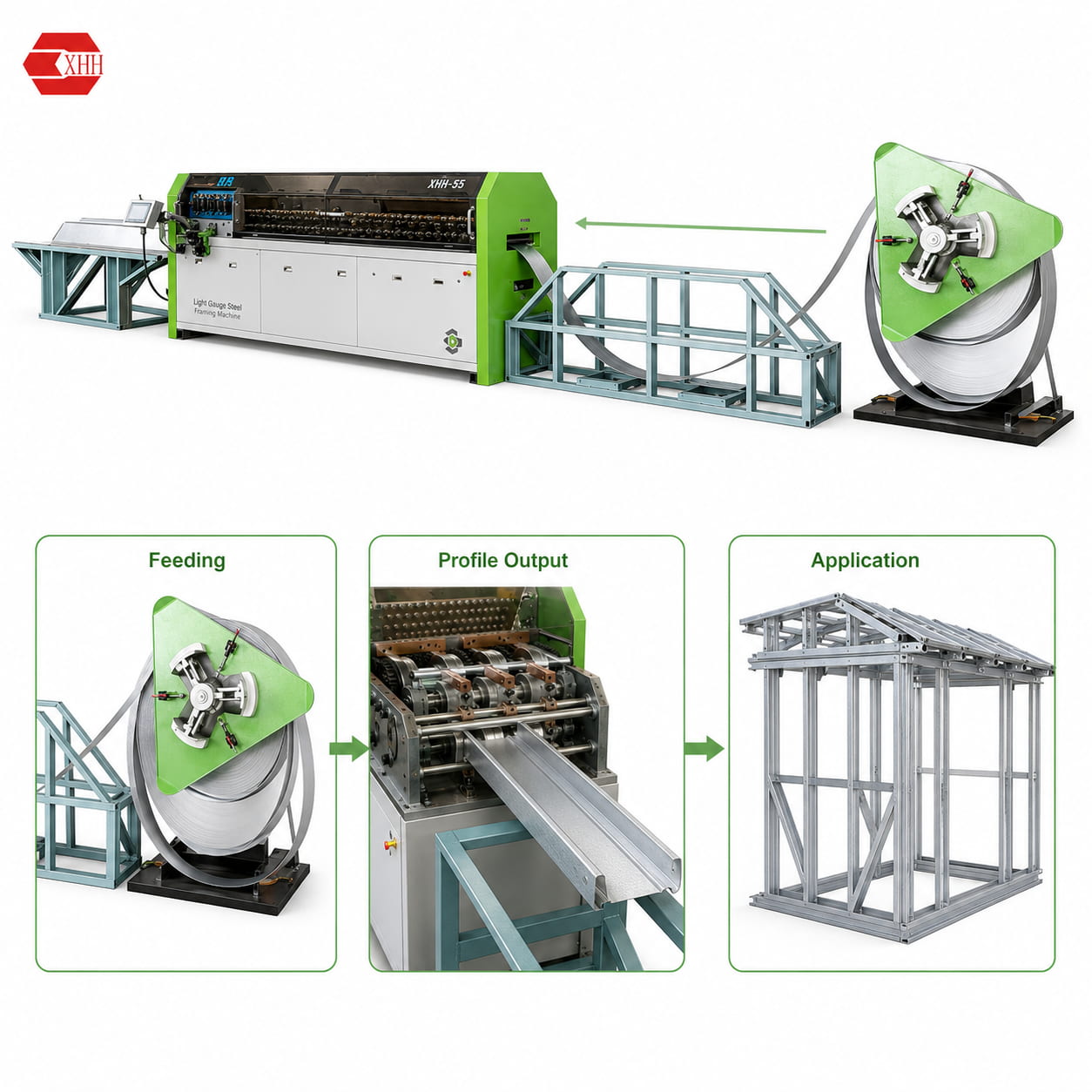
A C89 light gauge steel framing machine produces C-shaped wall and floor members with a nominal web width of approximately 89 mm. The exact profile dimensions, flange width, lip size, and hole pattern depend on the customer's structural design standard and building system.
C89 profiles are widely used for residential and light commercial construction because they provide a practical balance between structural strength, material consumption, transportation, and installation efficiency. Typical applications include modular houses, granny flats, villas, site offices, internal and external wall frames, and other low-rise buildings.
A C140 machine produces deeper light gauge steel sections with a nominal web width of approximately 140 mm. The larger section can provide higher stiffness and more space for insulation and building services, although the final structural capacity always depends on steel grade, thickness, profile geometry, bracing, connections, and engineering design.
C140 systems are often considered for projects requiring stronger wall or floor members, larger spans, higher loads, enhanced thermal performance, or a wider service cavity. Applications can include multi-storey light steel buildings, larger modular units, floor joists, commercial structures, and projects in regions with demanding wind, snow, or seismic design conditions.
The most visible difference is the web depth. C89 is commonly selected for standard wall framing and many low-rise modular applications. C140 is generally used when a deeper member is required for strength, stiffness, insulation, or service space. The correct choice must come from project calculations rather than profile size alone.
Before choosing a production line, buyers should confirm the complete section drawing, including web, flange, lip, rib, corner radius, and allowable tolerance. Two profiles described as C89 may still require different roller tooling if their detailed geometry is not the same.
Many light gauge steel projects use galvanized or zinc-aluminum coated high-strength steel. Depending on the profile and application, the base metal thickness may range from approximately 0.55 mm to 1.60 mm or more. Materials such as G450 and G550 require careful calculation of forming force, roller design, punching capacity, and cutting clearance.
A machine should not be selected only by the maximum thickness printed in a catalog. The supplier must evaluate the combination of yield strength, coating, strip width, profile shape, production speed, and hole quantity. A line designed for thin C89 material may need stronger drive and hydraulic systems to process a heavy C140 specification reliably.
A dedicated C89 line is efficient when the factory mainly produces one profile family. A dedicated C140 line offers the same advantage for larger sections. Manufacturers planning to serve several building systems should discuss whether separate tooling, cassette changeover, adjustable rollers, or a multi-profile solution is more practical.
Fast changeover can reduce downtime, but universal tooling must still maintain profile accuracy. The machine builder should confirm which dimensions are automatically adjustable and which parts require manual replacement or recalibration.
Light gauge steel production is more than roll forming. Each member may require bolt holes, screw holes, service holes, web notches, flange cuts, swages, and end cuts. These operations allow components to fit together accurately during factory assembly or on-site installation.
C89 and C140 profiles may use different tooling dimensions and punching forces. Buyers should provide sample frame drawings and a complete list of required functions. The number of hydraulic stations, tool layout, punching sequence, and line speed should be configured according to the actual building design workflow.
Catalog forming speed is not the same as finished production output. Real output depends on how often the machine stops for punching, notching, marking, and cutting. A project with many service holes may have a lower average production speed than a simple member, even when both use the same roll former.
When comparing quotations, ask suppliers to estimate output using representative component files. This gives a more useful comparison than the maximum no-load or forming-only speed.
Modern light gauge steel framing production often starts with architectural and structural design software. The project is converted into detailed wall panels, roof trusses, floor systems, and individual members. Manufacturing data is then sent to the machine control system, where each member is produced to the programmed length with the required holes and notches.
For a successful CAD/BIM-to-CNC workflow, the software and machine must agree on profile definitions, operation codes, tool positions, tolerances, and file format. Buyers should confirm compatibility before ordering instead of assuming that any framing software can communicate directly with any machine.
Choose a C89 light gauge steel framing machine when the main business is residential walls, small modular buildings, villas, granny flats, or similar low-rise projects and the structural engineer specifies an 89 mm profile.
Choose a C140 light gauge steel framing machine when the project needs deeper structural members, more insulation space, larger service cavities, heavier loading, or a 140 mm system specified by the engineer.
Some manufacturers benefit from owning both systems, but purchasing two lines is not automatically the best first step. Consider expected orders, local building codes, the profiles used by your design team, steel availability, operator skills, and the number of projects required to recover the investment.
A professional quotation should be based on real project data. Prepare the following information before contacting a machine manufacturer:
Xiamen Xinhonghua Machinery configures light gauge steel framing machines according to customer profile drawings, material specifications, production functions, and software workflow. Our team can evaluate the forming system, punching stations, cutting method, marking equipment, control architecture, and electrical standard as one integrated production line.
Send us your C89 or C140 drawings, steel thickness and grade, required hole patterns, project type, and software information. We will help you compare the two profile systems and recommend a practical machine configuration for your modular or prefabricated building production.
 IPv6 network supported.
 +86 13605085003
 sunnie@xhhjx.com